Lessons from a motorcyclist!


b06aae82a070ca033c8093924a3565fa
Tail of the Dragon- Tennessee/North Carolina
When given the option of going from Point A to Point B, a true motorcycle enthusiast will always pick the route that has the curviest roads. We might be able to get to Point B faster by taking the straight road (sometimes we ride 200 miles to go 60), but it isn’t as exciting and memorable as those roads that are scenic and challenging. You gain a greater skill set and appreciation for life when you take these curvy roads!

What if this was the philosophy that dominated the field of education? Many teachers feel that the best way to get information across to students is the linear model…the straight road. The kids will still learn this way, but it isn’t as exciting as learning the random and non-linear way. Learning in this way can be challenging and messy, but what you learn sticks with you longer. The curvy road way of learning is just a more exciting and eye-opening experience. Honestly, I think it is higher quality of learning.

We deserve to give kids the most exciting and memorable education that we can..let’s start taking the curvy roads and not the straight ones!


Ever get stuck on an escalator?

OLYMPUS DIGITAL CAMERA If you have never seen this video, it is worth watching!

Do you know any educators who are stuck on their own escalator? Are you stuck? While this image and video might make us laugh, there are those in education (and to be fair every profession) who are literally stuck in what they do. They are the ones who wait for someone else to set an agenda and make forward progress. They wait for “official” PD opportunities, avoid social media, etc. The sad part is that this has an impact on kids!

How do we help people who are stuck? How do we get them to take ownership for their own learning and not wait for someone to train them on a new teaching strategy? We could throw up our hands and say that there will always be educators like this, but what about those students in the classroom? Don’t all students deserve a rich classroom experience?

Schools can start by creating a culture where self motivated PD is not only encouraged but expected! The big question…What is the best way to foster this culture? I would love your thoughts!

Don Sturm

The kids just trust us!

IMG_7908

This view over the weekend from the driver’s seat of a small white bus (the kids call it the white rhino) while taking my scholastic bowl team to a competition caused me to have a deep thought. The kids just trust us! As I looked in the mirror, every kid was asleep on that REALLY  long ride. This may not sound like a huge surprise, but it got me thinking that they trusted me enough to not give a thought to me driving them. They have never questioned my ability to drive it or my safety record. I thought really hard about this to the point that I was more aware than normal. I looked a little more closely when I had to cross traffic or go through a busy intersection. Teachers and administrators should not take this trust for granted. Plain and simple, we have to keep in mind that students trust us to do what is right!

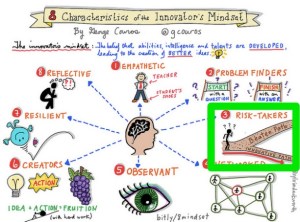
It is all about taking risks!

8-Characteristics-of-the-Innovators-Mindset

The biggest risk is not taking any risk… In a world that changing really quickly, the only strategy that is guaranteed to fail is not taking risks.

Mark Zuckerberg

I think we hear the mantra “take risks” all the time in the field of education, but the nature of our schools makes it difficult to go too far out on a limb. Personally, I think this is one of the issues holding schools back from getting better! There are always those who are working against teachers and educators taking risks because it will upset the way that things have always been done.

Having this risk taking characteristic is something that I have prided myself on from the time I started my teaching career in 1991. Obviously, the degree of risk taking varies from year to year, but I have always held the belief that you have to step out of your comfort zone to truly grow. Moving from the classroom to technology integration specialist has given me the opportunity to encourage others to take risks. So much of my current position involves getting educators to try new ways of doing things, which instantly takes them out out of their comfort zone. It takes a nuanced approach on my end because not all teachers and administrators are as comfortable as I am with taking risks. My style is to try to get teachers to think about what they want from their students in the classroom, which many times involves expecting students to step out of their comfort zone. If they expect this from students they should be more open to risk taking in their classroom/school. My philosophy is that no one should expect something of another person that they would not expect of themselves.

The fear and trepidation that comes from risk taking is what makes it such a valuable experience. If the risk results in a successful outcome, the confidence gained from that experience is invaluable! Conversely, if the risk doesn’t turn out successful, that experience also provides a teachable moment. We have to start looking at risk taking as a win-win situation. Risk requires a growth mindset toward the idea of failure. Failure should be a learning experience, not an excuse to quit innovating. If we expect our students to be resilient and learn from failure, we have to be prepared to do the same thing!

Don Sturm


Most Likely to Succeed

img_1175Wednesday night I had the opportunity to view the educational documentary Most Likely to Succeed. I had read the book a couple of years ago, and the movie was thought provoking. It really forces the viewer to think about how education is currently delivered to students. The movie is not yet available for purchases; instead, you purchase a one-time screening license for $350. The reason for this method of distribution, as stated by the executive producer Ted Dintersmith, is to “force” people to view it in groups and have a discussion about the ideas presented in the movie. While I would love to be able to encourage people to buy/rent the movie, I respect the philosophy behind not releasing it. This movie is really meant to be seen in groups!

I am going to push to have a community viewing for the community where I work to truly generate some conversation about how schools need to change. However, I would like some feedback from those elementary teachers and administrators. How do you see this working at the lower levels? I want to be able to provide specific examples of how the ideas that are present at High Tech High can be implemented in grade schools. It is one thing to say that a high school kid won’t learn the same breadth of content in this new paradigm, but how do kids learn the basics at the lower grades while still experiencing this “new” type of education? Is what is presented in the movie really more for middle and high schools? I have started a Google Doc where people can share their thoughts. Hopefully this is something that could help others who have the same types of questions. Please feel free to share the Doc with others.


Don Sturm

The process is important!

img_1028

Imagine…students working diligently on a project. They are interacting with each other. Their interest levels are peaked. They are seeking out new information. The teacher is happy, the students are happy, everything is right with the world. Then…the final product is turned in…and it is not very good. What happened? What grade do you as a teacher give to the finished product? You have a rubric that you live and die by, you really have no choice but to give a low grade. The final grade is not what the students expected.

As a former high school history teacher, I can speak first hand about how easy it is to forget the importance of the process of learning. High school teachers especially seem to focus more on the final product than the steps that students followed to produce that product. I am not sure if it is the content heavy nature of high school or the idea that students at this level are ready to be set out into the dog-eat-dog world, but there is a huge focus on final products. Educators, no matter the grade level, need to be sure to place an emphasis on the process rather than the final product.

Don’t get me wrong, at some point the final product needs to count for something. The key for those involved in educating kids is to find a balance of process and product. My biggest issue is that many teachers (myself included) give many one and done type of assignments. Students work for a set amount of time (days to weeks), turn in it in, and wait for a grade. The grade is given and the something new is assigned. The problem…many times the new project involves new skills that haven’t been honed through previous work. This process is repeated over and over throughout a semester or school year.

Wouldn’t it be better to incorporate a set of skills/standards that students would work to master throughout the course or year? In theory, every assignment or long term project would incorporate these skills/standards. This would allow students to use what they learn from each project to hone these skills over a longer period of time. Projects turned in at the end of the course or year would presumably be better than those turned in during the beginning of the year. This is true growth!

Probably one of the biggest hurdles to this type of thinking is the nature of grades in our education system. The belief that everything that students complete has to be graded and then recorded is pervasive in our society. Parents have to have something to see in the gradebook…don’t they?? This expectation is then carried over to assignments. If students complete and turn in an assignment, it is easy for a teacher to just look at that final piece of work and, in turn, the learning process is almost completely discounted. And…if the work is all done at home, there is really no effective way to assess the learning process. Thus, the push by some educators to do away with homework. While I am not suggesting that there is no place for homework, I do think that this makes a final grade almost always reliant on the final product and not the process.

How to implement this is the million dollar question! One thought gaining traction is to use more of a standards based grading system. This type of grading system allows students to work on standards that will be mastered over time. In this type of classroom, students are always assessed based upon their best work. I am currently working with a high school ELA teacher on this type of grading system. It is worth noting that this is being done within a traditional grading system, but grades do not appear until midterm and final report cards. This is what George Couros might describe as innovating within the box. As students work to meet standards, their best attempt is recorded. This is direct attempt to balance process and final product. Final products are always being assessed, but there is a focus on continual growth. The focus is on process.

The challenge for teachers is to at least be aware that the learning process is important. This awareness will hopefully lead to some discussions about how to assess the process and not just the product. It is also important to stress this idea to all involved in the education process: students, parents, administrators, and school board members. When showcasing work…focus on the process that was followed and the learning that resulted. Don’t always feel like you have to showcase the final video or presentation to others. In fact, don’t lead with the finished product, lead with process!

Don Sturm

Why I Do What I Do!

img_0803

Officially, my job title is technology integration specialist. Sounds pretty straightforward, right? I help people integrate technology into their teaching! My job is a little messier than the title suggests. A typical day may include any one or many of the following:


  • answering emails from teachers, students, and parents.
  • purchasing and pushing out apps to 2000+ devices.
  • locating lost iPads.
  • explaining the benefits of using ____ app or service.
  • troubleshooting problems with iPads.
  • defending the use of technology in the classroom.
  • attending meetings about technology.
  • visiting other schools to look at their technology.
  • working on Smart Boards, Macs, and PCs.
  • helping to manage the web filter and Google Admin. console.
  • visiting classrooms.
  • recording tutorial videos.
  • updating Google Classrooms to share information with teachers and students.
  • planning professional development activities, both online and inperson.
  • talking to sales reps.


I don’t list all of these to have people feel sorry for me, only to show that there is no real consistency to what I do everyday. There is not one of those jobs on the list that I hate doing, but there are those that I prefer more than others. I should mention at this point that I truly love my job. Sure there are times that I feel (frustrated, stressed, overworked, under-appreciated), but hey…that’s what it means to be involved in education!

Though to be completely honest, I want my position to focus more on discussions of how to best teach kids and less on most of the jobs listed above. If those discussions involve technology…great, but right now the focus seems to be more on the technology and less on the pedagogy behind it. As a result, those who are uncomfortable with technology see me as someone who wants to add something to their already full plate. Some of this is my fault, some of it is the fault of teachers and administrators, and some of it is no one’s fault. Schools are messy places filled with people who are pressed for time! Thankfully, there are those teachers and administrators in my district who I can count on to recharge my batteries when I need it. These are the people with whom I can always count on having a good discussion about growth mindset, Makerspaces, Breakout EDU, Twitter, etc. I’ll share two recent examples that exemplify why I do what I do everyday!

One of the hardest parts of leaving the classroom was leaving a co-teaching situation that I had been a part of for twelve years. Courtney (@CAEddleman) and I had MANY conversations about how to best teach kids, not just how fast we could move through content. It seemed that we were never satisfied with how we were doing things. Moving to this new position meant that I wasn’t going to be able to have those day to day conversations. A couple of months ago, after having read a couple of books about standards based grading, I asked her if she would be interested in trying this approach with her 12th grade expository writing class. We sat down and talked through what this change might look like and, in the end, she decided to give it a try this semester. She also became excited about the idea of Breakout EDU and has worked on incorporating this into her classroom as well as helping me present it to the faculty as a whole. Courtney has created a classroom environment where students are experiencing their teacher being excited to try new things!  Making big changes in how she teaches content seems to have renewed her excitement for teaching and in doing what is best for kids. To hear her say, “I can’t wait to see what the kids do with this” is why I do what I do everyday!

The other example relates to the conversations with the junior high principal Lee Hoffman (@HoffmanLee) about the possibility of a Makerspace and/or STEM lab in his school. These conversations, which have also included visits to other schools, have generated a lot of discussion about pedagogy that have been deep and focused on what is best for kids. Should the 7th grade experience be more “scripted” than the 8th grade? What modules do we want/need to include? How much should it focus on future career possibilities? What kind of teacher is needed for this type of experience? Discussions like these get me geeked up and excited about the possibilities! To see this principal talk about how awesome this type of change is going to be is why I do what I do everyday!

These are not the only two examples of conversations that I have had with teachers and administrators, but they don’t happen as often as I would like. From here on out, my goal is to make these types of discussions the rule rather than the exception. I am not naive enough to think that all of those aspects of my job listed above will disappear, but we have to create opportunities for deeper pedagogical discussions among teachers, administrators, students, and parents. This is how we will make schools better. This is why I decided to leave the classroom after 23 years. This is why I do what I do.

Don Sturm

Don’t be a Goob!

img_0468

What’s a goob? We all probably know at least one! You might even have another name for them. They are the negative ones who can and do ruin the possibility of something good just by their comments and reactions. They are the elephant in the room. If you aren’t a goob, you might get trapped in their web of negativity. You start to become goob like! If you are a goob, please stop because you are ruining it for others. Hmmm…the more I think about it, there probably aren’t many goobs reading this blog post 🙂

I write this post with the thought that we can’t just ignore this elephant in the room. Change is needed in schools and we can’t afford to let a small group (hopefully) of people distract us from sharing and implementing these necessary improvements. Please don’t misunderstand me, I am not talking about the teachers or administrators who have legitimate disagreements with specific improvements. We need a variety of research based opinions on our quest for a better education system! Goobs are those who will fight anything that is different just simply because…not because of any research.

It is uncomfortable to face the goob and, as a result, many times we just simply try to ignore them. I want to suggest a different approach. Why not talk about the goob, not as an individual, but as a group? What if we acknowledge the elephant in the room? The best outcome would see the goob change and be an open and a willing participant in the improvement process.  The worst case scenario would be that they do not change their minds and start to grumble to themselves, but at least they won’t poison the proverbial watering hole! What if school districts used a hashtag like #dontbeagoob as a way of putting them on notice that we won’t allow the goobs to bring others down? Planning a different kind of professional development activity? Use this new hashtag along with the “legitimate” ones to silence the goobs. Would this acknowledgment of the elephant in the room help to change the culture of a school? I don’t know, but I am willing to try it and see what happens.

Don Sturm

Choices, Choices, Choices

6352390786_a6db3c669a_b

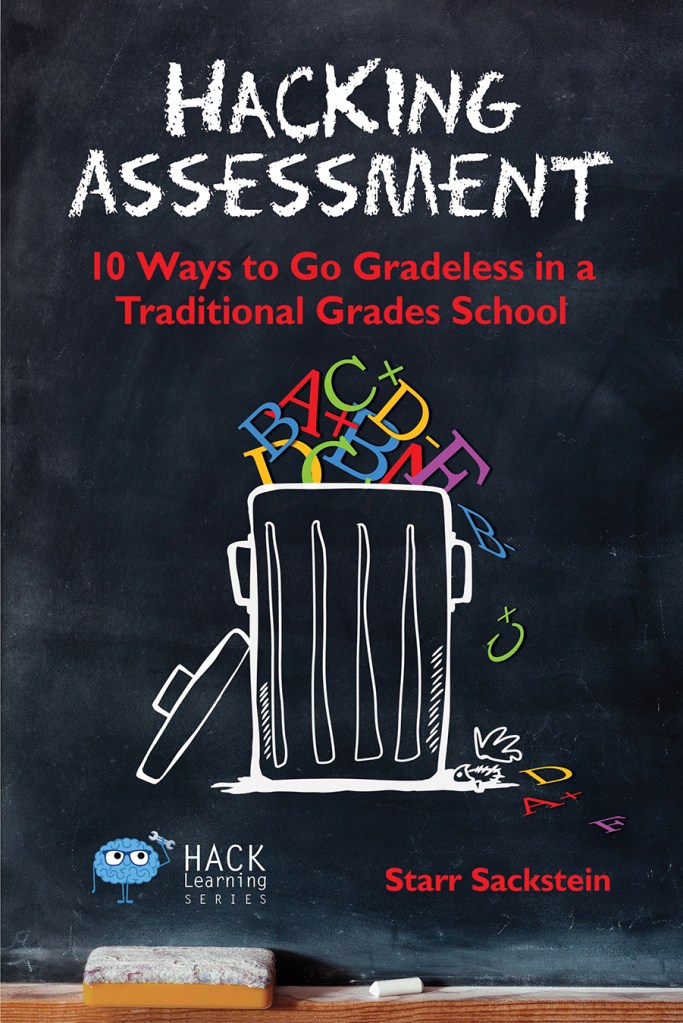
Today started as a normal weekend morning…get up, drink some coffee, look at Twitter, read a few blogs. The blogs I read always make me think, but my problem is that I can’t stop thinking about them. What I really thought (and thought, and thought) about this morning was how two very different blogs were actually related. The first  blog I read was by Starr Sackstein and focused on the idea that students don’t really know how to make choices because others regularly make decisions for them.

“Children start out naturally curious, asking a lot of questions and engaging with their environment as soon as they are aware of it and have the ability to do so. Then they enter the school systems and almost immediately have that autonomy taken away. It’s a slow, insidious process that systematically strips students of their ability to understand their own interests in academic or even purely passionate way, especially as it pertains to school.”

The next blog I read was by  Kenneth McKee. While his main focus was how instructional coaches can build relationships, one suggestion was to provide teachers a menu of services that instructional coaches can provide. This menu “forces” teachers to pick from a limited list of services. I assume that Kenneth’s decision to provide a menu stems from the fact that not providing any choices would be overwhelming to teachers. I should point out that he did include an “other” choice.

What these two blogs share is the idea that choices are something that many in the field of education have trouble making.  Why is that? Is it because both students and teachers are conditioned to having choice made for them by others? Is it a societal thing? Are we just presented with so many choices in our daily life that we actually like it when others make decisions for us? Does having someone else make decisions for us lessen our responsibility for the final outcome?

It seems that those who have been in a school setting for a long period of time are conditioned to do what others have told/ask us to do. The student is “told” what to read, write, draw, etc. While most teachers are probably not told how to teach, many are told what to teach as well as how long to teach (fill in the blank). We need to start consciously moving toward allowing/expecting students and teachers to make more choices. Making choices is a life skill? If you always have people making decisions for you, how will you ever learn to make them on your own? It would seem wise to allow students the ability to practice in a safe environment like school rather having have to make those choices out in the “real world” without the necessary skills to weigh options, which is necessary for any well thought out decision.

Building in more choice in our schools is imperative. Teachers will need to decide what areas choice can be provided to the student. For example, many schools have a set curriculum outlining what books must be read. If you are in a school like this, the choice may be focused around how the understanding of the book will be shown. When I was a classroom teacher, my colleague and I would provide four or five different modes that could be used for presentations. Students would randomly be assigned to one of these modes. The next project would involve jigsawing students so that there was at least one representative of each mode in the new group. These groups would then choose which mode was best for the new project.  Eventually students could use any mode that they thought would best meet the requirements of the assignment. This was our way of providing some guidance to students on how to make good choices.

Approaching the issue of choice with teachers is a bit more challenging. When presented with so many choices of how and what to teach, and ultimately assess, it is very easy for teachers to choose the way that it has always been done. This is the “safest” choice and requires the least amount of work. The life of a teacher can be a very demanding one. As a result, when trying to reduce workload, the easiest choice is sometimes seen as the “best” choice. Having access to instructional coaches is one way of helping. These coaches can and should start by providing some options from which the teacher can choose. Doing this will hopefully open doors for the teacher to feel comfortable exploring other ways of presenting and assessing their students.

Choice must become more a part of the education process. It allows both students and teachers to feel more of a sense of ownership.  This feeling of ownership has the potential to lead to great things within the education setting. What can you do to encourage more choice?

Don Sturm

There is no time!

110859301_5cc01c7ed5

Time is on my side.

Rolling Stones

Don’t you wish these song lyrics were true? Wouldn’t (fill in the blank) be better if I just had more time! Personally I could generate a LONG list of words to fill in that blank. The problem with this way of thinking is that you will NEVER have more time. Time will never been on our side. There needs to be more focus on what we do with our time rather than thinking about what would be possible with more time.

From a professional standpoint, time is what is needed to read about new research and ways of teaching, observe other teachers, reflect on your teaching practices, and on and on and on. I would argue that you need to step back and figure out how you can build in time for those professional aspects that are important. If you aren’t happy with how your students are responding to how you grade and/or teach, you NEED to take time to figure out what can be done differently. Think about the cycle if you don’t. You teach a unit…your students don’t seem to be enjoying it…you get frustrated…they test over the unit…the grades aren’t great…the students take 2 seconds to look over comments that you took hours making…you start the next unit upset… and the cycle continues. Imagine doing this for years! You must find the time to change things up.

But how? I wish I had an easy answer to this question, but it boils down to what many have told me, “you will make time for things that are important.” I say this not trying to offend or upset anyone, but it is true. It has been true for me, and I think it is true for everyone. If you want to lose weight, you’ll find the time. If you want to spend more time with your family, you’ll find the time. If you want to reconnect with your significant other, you’ll find the time. The same goes for your professional life. If it is important you MUST find the time or you will burnout and get frustrated. Neither of these are good for you, your students, your district, or your family!

Look at what/how you teach and ask yourself what you would most want to change. Pick up a book that helps offer alternatives and take the time to read it. Jump on Twitter and follow people who have fresh ideas. Search for blogs from teachers who have new ideas and are willing to share their experiences. Your first reaction will be that you don’t have time…make time! For years I have read every night before I go to bed. Most nights I was reading material that I could use to help make my classroom a better place. If you choose to read books, the reading list doesn’t have to be research heavy. In fact, I would recommend that your reading list include books that will help to inspire you to be a better teacher, not put you to sleep! This is my way of making a little time for professional growth.

Don Sturm

Recommended books: