

I want you to stop and think back to when you were growing up. That time when your parents and society as a whole saw you as a contributing member of society. That time when you were respected for your thoughts. That time when your culture was praised for having a beneficial contribution to the world. Are you seeing my point? I am assuming that most were thinking…yeah I wish that’s how it was. Instead we were told that our music, magazines, video games, friends, activities just weren’t what they were in the good ol’ days. I am fairly certain this has happened since the dawn of time, but it has never been productive to the current generation. It makes the current generation defensive and isn’t very productive. Think back again, when your parents told you your music was stupid, you instantly stopped listening to it, right? Not me (nor most of you I suspect), I played it even louder to try to prove a point. I like to call this nostalgia for the “better” times as culture shaming, and it really needs to stop.
If we truly want to help this generation of young people navigate the world, we need to at least try to understand the world in which they are living. Notice I didn’t say we need to completely embrace it, but we owe them the respect of at least trying to get it. Those in education like to throw out quotes like the cup is half-full, but we do that on our terms. We need to look at our students’ lives and see the cup as half-full. I hear so many teachers and parents say that the hyper connected lives of students is problematic. They never play outside, they are lazy, they are hooked to their phone, they don’t know how to have face-to-face conversations. I would bet that this connectedness actually allows them to have more “social” experiences than we ever did. Growing up, my friends were those people on my block who led basically the same type of life as that of my family. Many youth today have “friends” all over the U.S. and maybe the world. We can argue about the nature of the word friend, but there is a much broader social interaction available to the younger generation than ever before. Many use social media as a way to get out of the bubble that is their family and community. Yes…social media can be used for nefarious things, but let’s not just assume that is how students are using it. I would highly recommend that you read It’s Complicated: The Social Lives of Networked Teens by Danah Boyd. This will make you look at teens and social media in a different light!
So as educators and parents what is the opposite of culture shaming? I like the term culture curiosity. Curiosity doesn’t mean 100% acceptance, but it does mean a willingness to try to understand. I think that is what young people crave, a willingness for adults to understand and respect them. I have tried to gain a better understanding of SnapChat to get a sense of what students see in the platform. Maybe trying SnapChat will help you as a teacher to understand what makes your students tick. How can you leverage this platform (or others like it) to help students learn (see below)? You may think it is weird and useless, but just remember how you felt when you were culture shamed. The best option is for teachers to try to figure out how to incorporate those aspects of student culture and use them as a hook for student engagement and empowerment. Isn’t having a deep impact on students why you got involved in education?
Don Sturm
**I need to give a shout out to Tara M Martin (@TaraMartinEDU) for her “invention” of the #BookSnaps. These #BookSnaps are one of the reasons that I used SnapChat in this blog post. Obviously there are other aspects of student culture that can be explored, but SnapChat is one of the “in” things right now! #BookSnaps allow the user to interact with a text by using a photo of a page as well as images/emojis/drawings. It is a great way to make learning visible. I have included a couple of examples in case you aren’t familiar. As a side note, SnapChat does not have to be used to create #BookSnaps. Take a look at Tara’s Youtube playlist for other ideas.



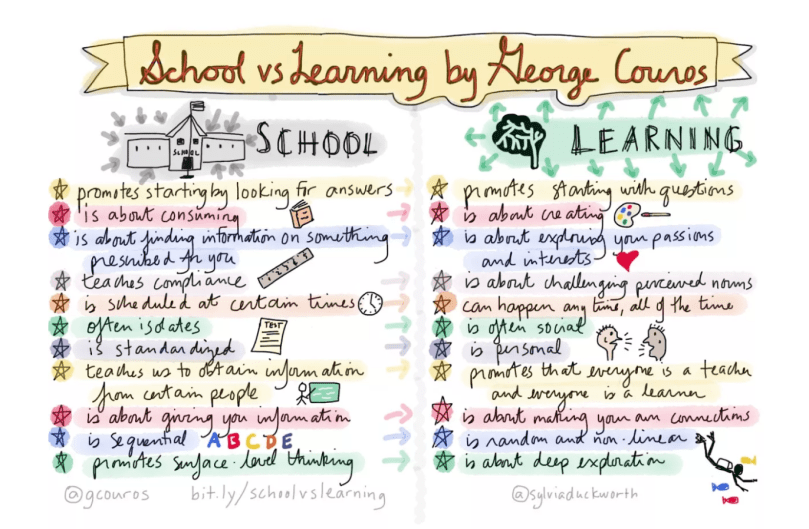



 This will be the third time reading The Innovator’s Mindset, but I am really looking forward to this new experience of a MOOC. I am currently in a book study with the leadership team in my district, so it will be interesting to see the differences between these two very different ways of exploring the book. I am hopeful that the MOOC experience of having access to so many people (1200+) will allow me to add to the in person discussions that we have about our district. It is also my hope that I will have many new ideas added to my toolbox that I can use in my role as a technology integration specialist.
 Naming a blog is hard work! Maybe not naming a child hard, but still challenging none the less. How can I capture what I might want to write about weeks, months, and hopefully years from now?? I think what I have chosen is fitting. School has been a part of my life in some way for the last 42 years and, as the title of my blog clearly states, I think that schools can be better. We are living in a time when we have to give strong thought to how schools serve students. It is no longer okay to teach kids the way that we were taught. It is not fair to students, nor society as a whole! Even though the district that has been my home for the the last 23 years is a high performing district that has high expectations for its teachers and students, there is still room for improvement. Not striving for something better will lead to stagnation and stagnation is not good for students. I should make it clear that this blog is in no way affiliated with Morton CUSD #709. My opinions are my opinions. In fact, there might be times that what I choose to write would not necessarily be supported by “my” district.
 Schools Can Be Better